Other Light
- Saodat Ismailova
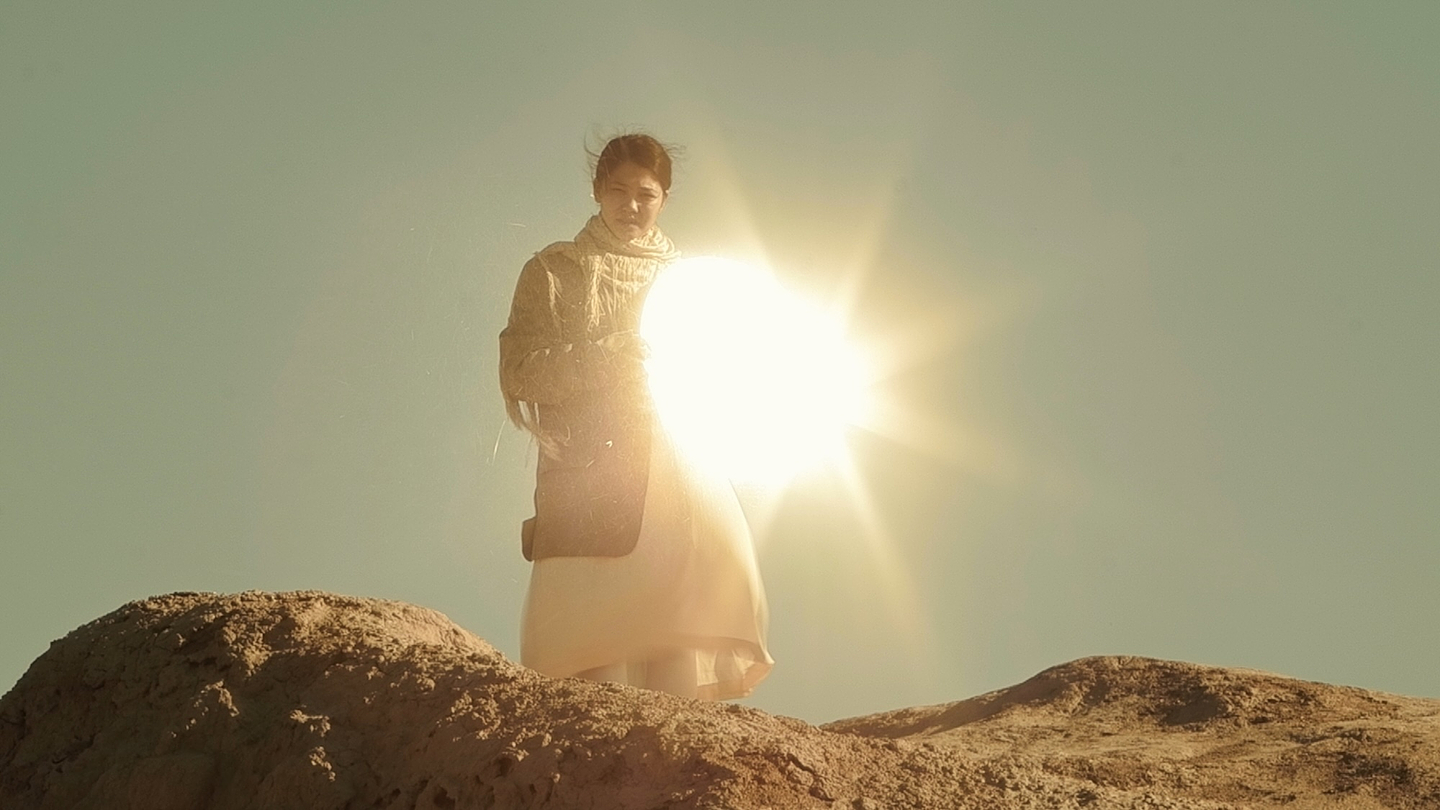
Western Front is pleased to present a solo exhibition by artist and filmmaker Saodat Ismailova. Bringing together two films Melted into the Sun (2024) and To the Throat of the Sun (2026) in a site-specific installation, the exhibition explores light as a political and spiritual force through which history, memory, and myth are continually remade.
Rooted in the layered histories of Central Asia, Ismailova’s films draw on oral traditions and cosmologies to trace ancestral knowledge that persists despite political and environmental upheavals. Raised in post-Soviet Uzbekistan, her engagement with the region’s histories and cinematic traditions shapes a practice attuned to spiritual longing, ecological transformation, and fractured relationships to the land. Moving between past, present, and future, her works bring the forgotten, silenced, or erased into dialogue with the present, where memory is carried through ritual, landscape, and relations between the human, more-than-human, and mystical.
Installed alongside kurpachas—traditional Central Asian quilted mattresses that accompany life from birth to death—the films unfold around the enigmatic al-Muqannaʿ (The Veiled One), an eighth-century spiritual and political leader. After leading a revolutionary movement, al-Muqannaʿ became a mythical figure, and legend holds that he wore a veil to conceal a radiant light emanating from his face. Through his story, Ismailova explores tensions between revelation and concealment, spiritual knowledge and political authority, and how visions of collective emancipation remain entangled with violence and sacrifice.
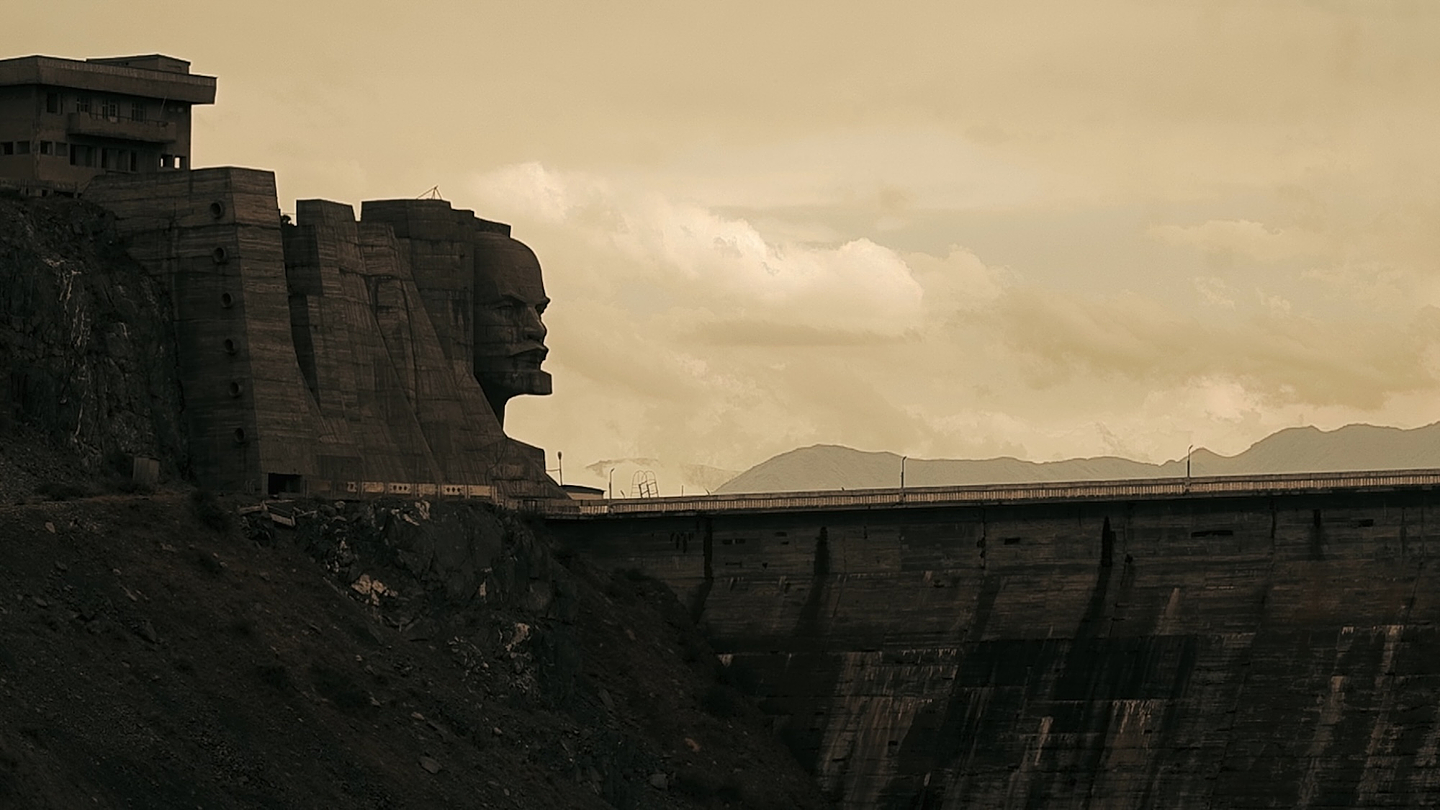
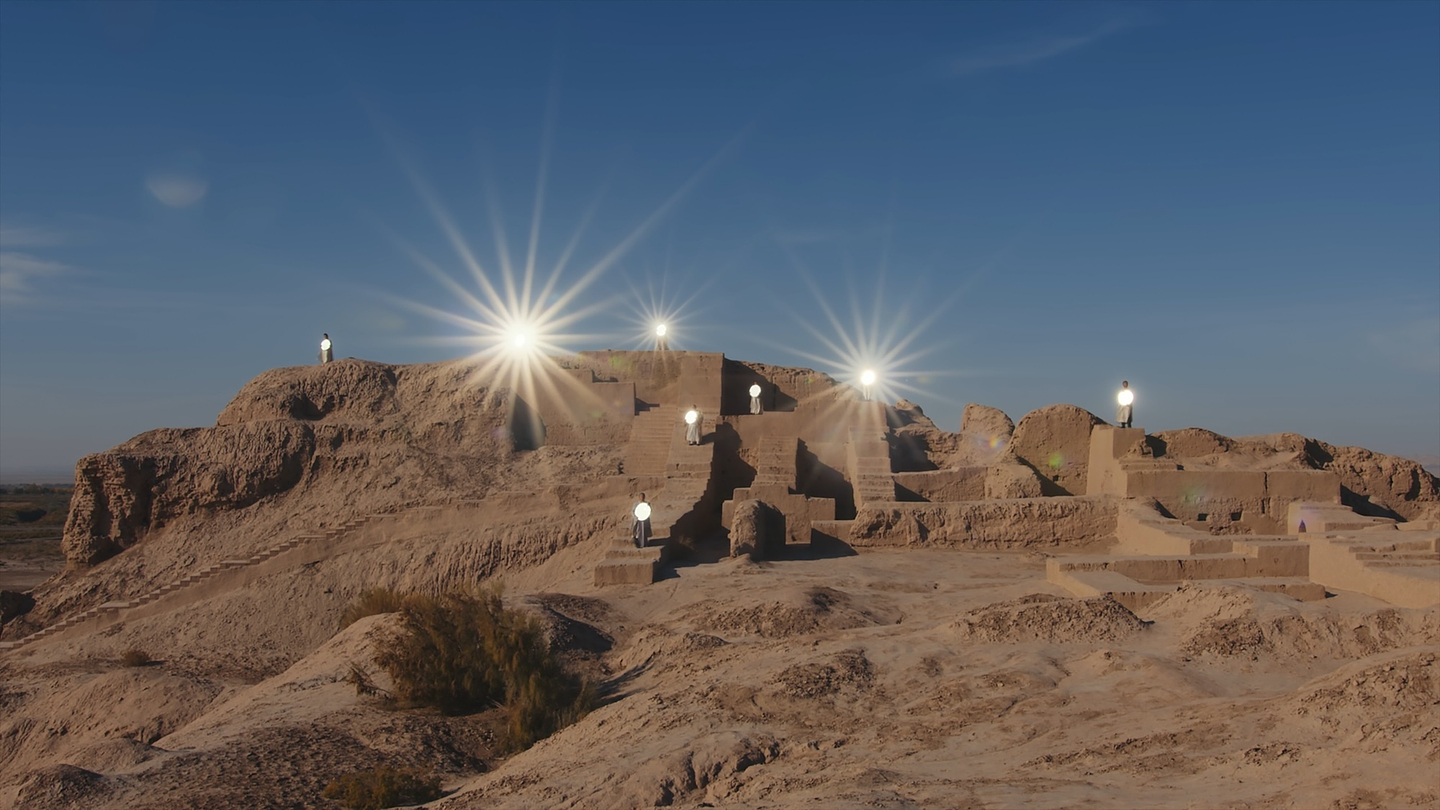
Bringing together ancient Iranian and Islamic philosophies, archival material, and filmed landscapes, Melted into the Sun is guided by light as myth, revelation, and cinematic material, reflecting on the afterlives of revolution and the environmental legacy of Soviet nuclear testing in Central Asia. Rather than presenting the past as fixed or linear, Ismailova approaches it as cyclical, continually rewritten as memory moves through bodies, places, and systems of belief. The film traces the entanglement of revolution, cosmology, and land, suggesting each shapes the others.
To the Throat of the Sun extends these concerns through an abstract meditation on perception, transformation, and the thresholds between illumination and obscurity. Reintroducing figures, gestures, and landscapes from Melted into the Sun, the film shifts from historical reflection toward a more elemental experience of light, reconfiguring boundaries between vision, consciousness, and the world. In doing so, it opens onto questions of transformation and how imagined futures might take shape.
Melted into the Sun is thirty-six minutes and To the Throat of the Sun is twenty-five minutes in duration. The films screen consecutively every hour on the hour.
Curated by Suzy Halajian, the exhibition builds on her ongoing collaboration with Ismailova, following her first Los Angeles exhibition Other Time at JOAN in 2024.
About the Artist
Saodat Ismailova is a filmmaker and artist based between Paris, France and Tashkent, Uzbekistan. Her work explores the relationships between memory, perception, mythology, and the moving image. Drawing on the intellectual and oral traditions of Central Asia, alongside dreams, rituals, and historical archives, she investigates how forms of knowledge survive erasure and political rupture, shaping individual and collective consciousness across generations. Working across film, installation, sculpture, and sound, Ismailova creates works in which documentary and myth, history and lived experience, and the visible and invisible converge, treating memory not as a record of the past but as a living force that continually reshapes reality. In 2021, she co-founded Davra, a collective dedicated to fostering artistic research and cultural exchange across Central Asia. In 2022, Ismailova participated in both the 59th Venice Biennale and documenta fifteen. She is the recipient of The Eye Art & Film Prize (2022), Foundation Pernod Ricard’s Nouveau Programme Award (2025), and the Art Basel Golden Award (2025).
About the Curator
Suzy Halajian is a curator and writer based in Los Angeles, where she serves as the executive director and curator at JOAN. Her practice is invested in long-term collaborations with artists, and examines the intersections of art, politics, and social histories, with a particular focus on image-making, colonial histories, and contemporary surveillance. She has curated exhibitions and public programs at institutions including the Hammer Museum, Los Angeles Contemporary Exhibitions (LACE), ONE Archives at the USC Libraries, Kunstverein (Amsterdam), UKS (Oslo), Galerie Hubert Winter (Vienna), and the Sursock Museum (Beirut). Halajian’s writing has appeared in BOMB, X-TRA, ArteEast, Ibraaz, and other publications. She holds an MA from Bard College’s Center for Curatorial Studies and is currently a PhD candidate in film and digital media at the University of California, Santa Cruz.
Accessibility
Western Front’s gallery is a ground floor, wheelchair-accessible space. A partially accessible all-gender bathroom is available.
What to expect: This exhibition is low-lit and includes video and amplified sound. Portable seating is available upon request at reception.
Alternative formats: The videos feature captions in English.
Further details about visiting and accessibility at Western Front can be found here.
Acknowledgements
Presented with support from the Audain Foundation.

Western Front is a non-profit artist-run centre in Vancouver.
We acknowledge the xʷməθkʷəy̓əm (Musqueam), Skwxwú7mesh (Squamish), and səl̓ílwətaʔɬ (Tsleil-Waututh) Nations as traditional owners of the land upon which Western Front stands.